The Silent Mother

Esoteric & Historical Gravidity & Parturition

  • Discourse
    • All Topics
    • Advisement
    • Birth is Beautiful
    • Dirty Secrets
    • History
    • Medical Museums
    • Personal Collection
  • About
    • Author
  • Shop
    • Etsy Shop
    • eBay Shop
  • Publications
    • Occupational Bloggings
    • Further Treatises
  • Resources
  • Contact
    • Donate

Testify – Mothers Venerate Read and Extol Read’s Method, Part 6

February 7, 2019 By Deena Leave a Comment

“Dear Sir: I guess this will be one of the many letters you will receive from gratified mothers but I feel I must write and thank you for your wonderful book… Thank you in the name of all the mothers who have read your book and have been influenced by it to have a happier, healthier childbirth.” Anonymous, April 25, 1947[1]

Mothers and soon-to-be mothers adored Read and sang his praises. From one of these letters, “As soon as we thought I was pregnant, we bought your books. Our reaction to these books? How we wish you were here – or we were there? Also, we feel that you must be not only a superb obstetrician, but also a wonderful person.”[2]

Read preached his revelation of natural childbirth to women on an emotional level with the passion and fervor of a preacher whose faith in God was as visceral and tangible as Read’s method was to women. Read’s reluctance to engage with the medical community, beyond writing embittered letters and giving vociferous lectures was one of the things that endeared him to women.[3] Read garnered support and praise from mothers because he offered them an enlightened alternative to a system of medical intervention that was dehumanizing during childbirth.

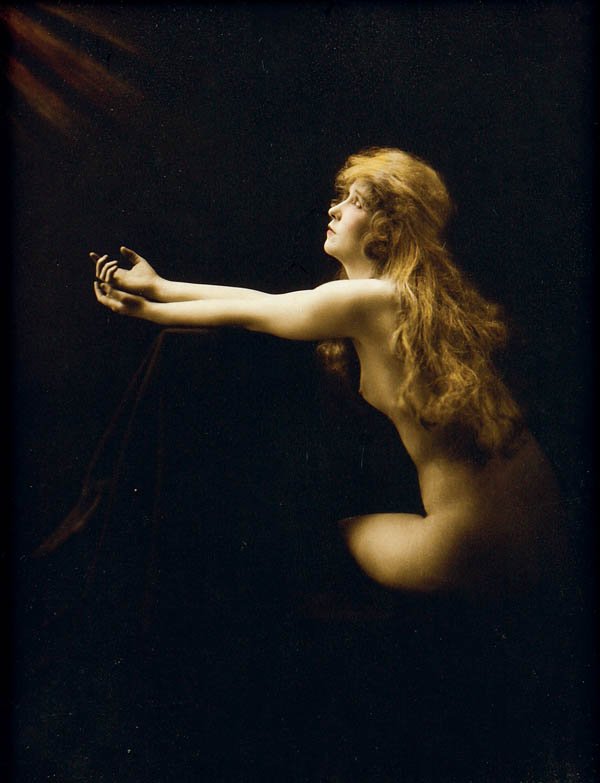
He also won them over because he gave them the one thing they needed, hope. Hope that birth could be pain free and they could have control over their bodies and their situations during labor. Read collected hundreds of letters of testimonial from these mothers, lauding him and his methods.[4]
A ray of hope

These testimonials not only show the faith the authors of the letters had in Read, but they provide the support needed for others to choose Read’s method. Patients need to have faith and trust in their physicians’ methods and prescriptions to have a successful relationship. If a patient doesn’t have faith in the physician, then they don’t have faith the treatment. In this way physicians can be viewed in a similar light to clergy and their relationship to God.

Vanderpool draws the parallel between physicians and priests, “They use powerful symbols to convey the meaning and validity of what they do–exemplified, for example, by wearing white coats symbolic of laboratory science, purity, and life. And they evoke in patients’ certain moods and motivations – including trust and great seriousness – that are conducive to their healing roles. Religious and medical professionals thus rely upon certain common dynamics.”[5] This common model of a calm, trustworthy authority figure is evoked with both a priest and a physician. Read capitalized on this with in his interactions with the mothers with whom he worked to draw and engage new followers.

Read was, and still is, worshiped by the mothers who praised him. He is seen as a savior to them, freeing them from not only the pain of childbirth, but also of the fear of the pain of childbirth. He gave them a way out by laying out the path for them with his method.  The question then arises, was Read a success with the mothers because they had faith in his method, or because they had faith in him?

Next Up: Sermons and Stories – Drawing the Listener in to the Community of Believers


[1] Thomas, M. (1997), Postwar Mothers, Childbirth Letters to Dr. Grantly Dick-Read (1946-1956), p. 168 – 169

[2] Thomas, M. (1997), Postwar mothers, childbirth letters to Dr. Grantly Dick-Read 1946-1956, p.113

[3] Caton, D. (1996), Who said Childbirth is Natural? The Medical Mission of Dr. Grantly Dick-Read, p. 959

[4] Thomas, M. (1997), Postwar mothers, childbirth letters to Dr. Grantly Dick-Read 1946-1956 and the 63 boxes of letters in the Wellcome Collection in the UK.

[5] Vanderpool, H. Y (1990), Religion and Medicine, how are they related? p. 10

Bibliography, Deena Blumenfeld, The Silent Mother, Dr. Grantly Dick-ReadDownload

Become a Patron!
Do share this article with your friends.

Filed Under: All Topics, History Tagged With: Childbirth, Dr. Grantly Dick-Read, History of Pregnancy & Childbirth, Medical Anthropology, Medicine, Motherhood, Mothers, Natural Childbirth, Obstetrics, Testimonials

Grantly Dick-Read’s Martyrdom – But Through Faith Alone… Where’s the Evidence? Part 5

January 31, 2019 By Deena Leave a Comment

The complaint of Read’s critics is that his method, and the fervent faith the mothers have in both the method and in Read himself, challenge the way they practice medicine and the validity of the profession of obstetrics itself, at times devolving into direct attacks such as Read’s comments on “meddlesome midwifery”. Read says, “Our evolution must develop on the psychosocial level, if at all, and, therefore, the science of obstetrics, in the teachings of natural childbirth, by the use of the natural or physiological equipment, by which we have attained our present relative pre-eminence, is more likely to preserve a progressive evolution than the presumptuous interference and mutilation of the products of the original and successful design.”[1]

In other words, Read believes that God’s design in pregnancy and birth is something that ought not to be manipulated or controlled by physicians. This, with good reason, encouraged criticism.

According to Moscucci, Read’s “Medical colleagues criticized the scientific basis of natural childbirth and its suitability to hospital practice.”[2] In 1962 Fielding writes, “Doctors today are warning each other that the Read method, its variations, and the teachings of other theorists that prenatal ‘preparation’is a substitute for medical assistance, have created new anxieties about childbirth that are potentially more harmful than the old ones. Whereas an ‘unprepared’ woman might once have been unduly frightened of the pain of labor, today’s ‘Natural Childbirth’ patient may learn to fear the ‘evils’ of medication instead.”[3] Fielding tells us that this fear of medication or fear of the medical institution is damaging.

Nevertheless, Read believes, “Motherhood offers all women who have the will and the courage to accept the holiest and happiest estate that can be attained by human beings.”[4] If birth is natural and women can attain their highest state of being as mothers without fear, pain or medical intervention through the use of Read’s method, what value has an obstetrician, or any medical provider in the case of a perfectly normal, physiologic experience?

Read also antagonizes his colleagues with vitriolic rebukes to their criticisms. From a letter to the editor of the British Medical Journal in June 1958, Read says, “[…] draw attention to the cult of interference which has become the priority danger of childbirth […] Early interference in obstetrics, without clinical indication, is prompted by ignorance, fear or convenience. Inadequate clinical experience beget doubts and anxieties.”[5] He goes on to say “Familiarity with the natural and physical law has enabled us to explain, and so avoid, the cause of many defects in cultural reproduction. Observations on women already made pathological by interference may demonstrate the details of disturbance but will only complicate the search for causes.”[6]

Here, he dismisses his colleagues’ research efforts with a flip comment about how they, the physicians, have caused problems during labor and birth with their meddlesome behaviors. Read may be correct in this matter, but his language is off putting to those to whom it is addressed.

The righteous indignation and caustic language Read uses fuels the belief that Read is a zealot, rather than a medical professional, as depicted by Fielding.[7] Read’s refusal to engage in proper study of his own methods and beliefs to determine if they are effective or if they cause harm further push Read to the outside fringes of the medical community.

Martyred for his cause or self-proclaimed martyr?

In a letter to the British Medical Journal, R. Christie Brown and E. R. Rees write in regard to Read’s commentary on primitive peoples labors being painless and therefore so should labors of white women, “But these people belong to a pure racial type in whom the shape of the head and the types of pelves are almost a constant. We, however, have to deal with a very hybrid race… It is hardly surprising, therefore, that the slight derivation from normal is a very common occurrence. We presume that Dr. Grantly Dick-Read would not expect such cases to be ‘quite painless.’”[8] In essence, they make the claim that had Read done a modicum of research, rather than relying on his own experience, he would have come to a different, albeit racist, conclusion.

Read states in Childbirth without Fear, “My own personal and professional experience is sufficient to enable me to draw conclusions and to support them with apparently sound evidence. The value of a theory lies ultimately in the results obtained by its practical implementation.”[9] This implies that his faith over that of empirical data, is what is truly valuable. The faith which he packages and sells to his clientele.

This goes as far as South Africa refusing Read a medical license and Read being sanctioned for advertising in Britain.[10] Read’s book sales and speaking engagements were viewed as advertising. Physicians were not permitted to do such things by their governing body.

It was Read’s dogmatic beliefs that render him a martyr to his cause and as an outcast from his community of physicians. Read essentially asked his scientifically minded, medical colleagues to take him at his word, on what he has witnessed and the revelation he has had about Natural Childbirth than based on empirical evidence. Read’s adamant refusal to conduct scientific study and rely solely on what his own eyes witness and the testimonial of the mothers who’ve had natural birth with Read’s method are at best off-putting and at worst ostracizing for Read. As a staunch defender of his method, he vigorously waved away those critical of his method and reinforced his disinterest in doing research beyond what his own eyes told him. Yet, even with all the fight and bluster, the women who engaged with Read and his method adored him.

Next up: Testify – Mothers Venerate Read and Extol his Method.


[1]Read, G. D. (1942), Childbirth without fear, p. 23

[2]Moscucci, O. (2002), Holistic Obstetrics: the origins of “natural childbirth” in Britain, p. 171

[3]Fielding, W. L. (1962), The childbirth challenge: commonsense vs. “natural” methods, p 57

[4]Read, G. D. (1942), Childbirth without fear, p. 6

[5]Read, G. D. (1958), The British Medical Journal, Induction of Labor, p. 1478

[6] Ibid.

[7]Fielding, W. L. (1962), The childbirth challenge: commonsense vs. “natural” methods, pp. 55 – 59

[8]Brown, R. C and Rees, E. R., (1945), The British Medical Journal, p. 924

[9] Read, G. D. (1942), Childbirth without fear, p. 18

[10] Thomas, A.N. (1957), Doctor Courageous, p. 192-193

Bibliography, Deena Blumenfeld, The Silent Mother, Dr. Grantly Dick-ReadDownload

Become a Patron!
Do share this article with your friends.

Filed Under: All Topics, History Tagged With: Childbirth, Dr. Grantly Dick-Read, Faith, History of Pregnancy & Childbirth, Medical Anthropology, Medicine, Natural Childbirth, Religion, science

Dr. Grantly Dick-Read: Faith vs. Medicine – Conflict Theory or False Dilemma? Part 2

January 10, 2019 By Deena Leave a Comment

Before we delve in, a point of clarification: For the purposes of this article, the word faith will have a few different usages. The term will refer to religious faith, faith in god or faith in the religious institutions. Faith will also refer to faith in the physician from the perspective of the patient, as well as faith in one’s self. I am intentionally using the term’s interchangeability because I believe that religious faith is not dissimilar from faith in one’s physician or faith in one’s self which will be elucidated further on.

Roth approaches religion (faith) and medicine from the perspective of conflict. “To the scientists who hold no brief for religion, the ancient antagonism of the church to science is difficult to overlook.”[1] Barbour refers to this as the “conflict thesis”, which he says, “originated in the after math of the Darwinian controversy.”[2] This he also describes as “oversimplified”. The conflict theory neglects to look at any connections faith and medicine may have and assume one correct perspective. I tend do agree with Barbour on this, as does Levin in taking a more nuanced approach to the discussion of faith and medicine.

Barbour refers to this as the “conflict thesis”, which he says, “originated in the after math of the Darwinian controversy.”[2] This he also describes as “oversimplified”. The conflict theory neglects to look at any connections faith and medicine may have and assume one correct perspective. I tend do agree with Barbour on this, as does Levin in taking a more nuanced approach to the discussion of faith and medicine.

According to Roth, “Religion and science do share one common feature that is beyond argument. Each has its own faith, although they are centered in different principles. Religion places faith in there being a Lord of the universe. Science lets its faith repose a dictum of the classical Greeks to the effect that all features of the universe can ultimately be explained by the methods of science […] If both show a propensity to harbor a faith, that fact alone may be ground for collaborative participation in joint endeavors.”[3] The expression of that faith will vary, but at its core, faith is fundamental for people to move through life’s transitions. In this case the context of the transition of pregnancy and childbirth, from individual to mother.

Levin, sees the conflict thesis as a false dichotomy because the literature in various academic fields use their own, somewhat narrow perspectives to argue their points, rather than being in conversation with one another, “the topic of faith and medicine (both terms loosely defined) remains a consistently marginal subject within Western medicine, due in part to the tendency for academicians from divergent fields and disciplines to work at advancing different agendas in isolation from each other.”[4] This lack of interactive conversation leads to the belief that faith and medicine are in their own corners of the boxing ring in an adversarial relationship, rather than being able to see the congruity.

Levin tells us that medicine is a problem for faith and that faith is a problem for medicine. These two meta-approaches mean that “faith engaged through a scientific, or medical-scientific, lens so that insights may be brought to bear on how faith-related constructs contribute to medically defined outcomes.”[5] In other words, the faith of the patient has direct impact on medical treatment and the results of such treatment. Here, I am in accord with Levin’s premise.Faith is a contributing factor to the social determinants of health.

The other meta-approach Levin mentions is that faith is a problem for medicine. This has to do with how the medical provider or medical institution are viewed through a religious lens. “The domain of faith has something to vital to say to and about the domain of medicine, drawing on the understandings of the prophetic role of religion, of theodicy and social justice, and of the way in which divine law defines norms of human actions.”[6]

There is a well-established assumption that secular medical practice supplanted religious responses to illness.[7] I don’t find this to be the case. Faith and the spiritual part of medical practice morphed to inform the structure of medical practice overall and that physicians’ faith is still integral to their practice.  When we look at medicine from a wider perspective, we see any number of issues where faith not only informs medicine but is part of medicine. Issues like end of life care, giving or receiving of blood products, stem cell research or usage, circumcision, vaccines, abortion,birth control, and analgesia during childbirth are only a few highlights of issues commonly described as a conflict between faith and medicine with only one resolution possible.

However, seeing these as conflicts is only one myopic perspective. I’d venture to call it a fallacy of false dilemma. I see another option, that of faith and medicine, with the two as being deeply interconnected.Read’s strong adherence to the dogma which he preaches, and the devotion of his followers bolsters the argument that faith and medicine are truly inseparable.When we start to dig into these issues, we find that they exist at the intersection of medicine and morality where scientific evidence will not sway the believer from their position of faith as evidence to the contrary most often causes the believer to believe more staunchly in their faith.

Even as we look to contemporary discussion over natural childbirth versus a more medically managed model, the argument and counter arguments are still the same. Fundamentally, it becomes a somewhat dogmatic discussion of “I believe” from both sides. The argument becomes that of belief in the self with the inherent trust in nature or belief / faith in medicine and physicians.  Where a person places their faith and trust,be it in self, God or physician, the model and practice of faith is shared while the expression of such faith differs. This interconnectedness, and the parallels contained within, are not seen by Read’s contemporaries, yet the scholarship presents a strong case for it. To understand how Read came to be at the intersection of faith and medicine, we need to first look to the genesis of his ideas.

Next Up: Read’s Origin Story and Background


[1]Roth, N. (1976), The Dichotomy of Man: Religion vs. Science, p. 152

[2]Barbour, I. G. (1997), Religion and Science, historical and contemporary issues, p. 24

[3] Roth, N. (1976), The Dichotomy of Man: Religion vs. Science, p. 153

[4]Levin, J. (2018), The discourse on faith and medicine, a tale of two literatures, p. 267

[5]Levin, J. (2018), The discourse on faith and medicine, a tale of two literatures, p. 269-270

[6]Levin, J. (2018), The discourse on faith and medicine, a tale of two literatures, p. 272

[7]Mann, S. (2016), Physic and divinity: the case of Dr. John Downes MD (1627-1694), p.464

Bibliography, Deena Blumenfeld, The Silent Mother, Dr. Grantly Dick-ReadDownload

Become a Patron!
Do share this article with your friends.

Filed Under: All Topics, History Tagged With: Childbirth, Dr. Grantly Dick-Read, Faith, History of Pregnancy & Childbirth, Medical Anthropology, Medicine, Natural Childbirth, Pregnancy, Public Health, Religion, science

  • « Previous Page
  • 1
  • 2
  • 3
  • 4
  • 5
  • Next Page »

Follow Us

Visit Us On FacebookVisit Us On InstagramVisit Us On TwitterVisit Us On YoutubeCheck Our FeedVisit Us On Pinterest

Subscribe to The Silent Mother

Receive our blog posts in your in-box so you never miss a thing.


Donate

Please support The Silent Mother through Ko-fi.

Your generous donation allows me to keep writing.

Topics

Altruism Antique Medical Equipment Birth Control Bodily Autonomy Childbirth Childbirth Education Contraception Dear Diary Death Dr. Grantly Dick-Read Education Eugenics Faith Feminism Giving Birth With Confidence Good Girl Historical Fiction History of Pregnancy & Childbirth Human Rights IUD Labor Lamaze Medical Anthropology Medicine Motherhood Natural Childbirth Obstetrics Pain Personal Collection Physician Planned Parenthood Pleasure Politics Preaching Pregnancy Pro-choice Public Health Religion Reproductive Rights science Scopolamine Sexuality Twilight Sleep videos Women's Rights

Copyright © 2026 · Deena Blumenfeld · The Silent Mother

Visit Us On FacebookVisit Us On InstagramVisit Us On TwitterVisit Us On YoutubeCheck Our FeedVisit Us On Pinterest