The Silent Mother

Esoteric & Historical Gravidity & Parturition

  • Discourse
    • All Topics
    • Advisement
    • Birth is Beautiful
    • Dirty Secrets
    • History
    • Medical Museums
    • Personal Collection
  • About
    • Author
  • Shop
    • Etsy Shop
    • eBay Shop
  • Publications
    • Occupational Bloggings
    • Further Treatises
  • Resources
  • Contact
    • Donate

The Revealed Obstetrics of Dr. Grantly Dick-Read and the Entanglement of Faith and Medicine, Part 1

January 3, 2019 By Deena Leave a Comment

This is the first installment of a multi-part exploration of Dr. Grantly Dick-Read’s valuation of faith over evidence-based medicine. A new installment will be released weekly.


“There is a gulf between the limitation of science and the source of an omniscience which gives life and guides us in the usage of faculties beyond our comprehension.” [1]

-Dr. Grantly Dick-Read
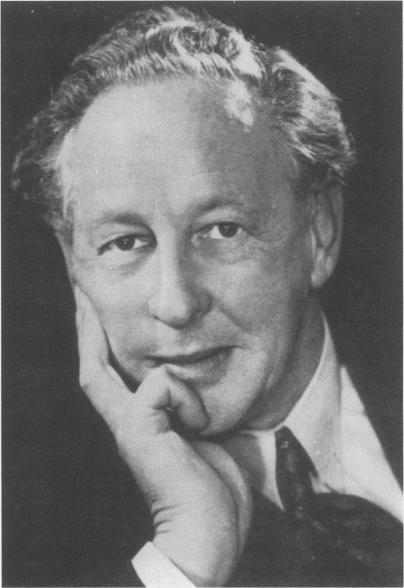

Dr. Grantly Dick-Read

It is a generally accepted trope that science and religion, or in this case, medicine and faith, are on opposing teams; playing the same game but involved in constant rivalry with one another. More recent research proposes that the rivalry between the two sides is not a rivalry as such, but it is more of an interconnected kinship where the two cannot be separated without losing the full scope and context of the discussion involving faith and medicine,especially when we explore other physicians’ relationship with faith, both historically and contemporary.  I will analyze the relationship between medicine and faith in the form of a case study of Dr. Grantly Dick-Read (1890-1959), author of Childbirth Without Fear (1942) as an exemplar of this intersection.

Read coined the term “natural childbirth” in an era when childbirth was moving from home to hospital where it was being medically managed.  Read was a self-styled prophet who claimed to have received his revelation of “Natural Childbirth” from God,and who preached his gospel to mothers throughout the UK and eventually Western Europe, America and South Africa. His ideas, though not truly unique, met with great acclaim from the white, middle class, mothers who used his method in the mid-20th century. Read’s critics and detractors, both past and contemporary, view his theory, method and practice as unscientific, potentially dangerous and contrary to the obstetrical practices at the time.

I propose that the medicine versus faith argument presented by the medical community and by other scholars is incomplete and narrow, not only with regards to Read’s writings but also within the larger conversation of how faith and belief intersect with medicine. Read’s work illustrates the complex nature of this discussion and of the narrowness of the idea that these are incompatible and opposing positions, specifically in the context of pregnancy and childbirth.

Next up: Faith vs. Medicine – Conflict Theory or False Dilemma?


[1]Read, G. D. (1942), Childbirth without fear, p. xv

Bibliography, Deena Blumenfeld, The Silent Mother, Dr. Grantly Dick-ReadDownload
Become a Patron!
Do share this article with your friends.

Filed Under: All Topics, History Tagged With: Belief, Childbirth, Dr. Grantly Dick-Read, Faith, History of Pregnancy & Childbirth, Medicine, Natural Childbirth, Obstetrics, Pregnancy, Public Health, Religion

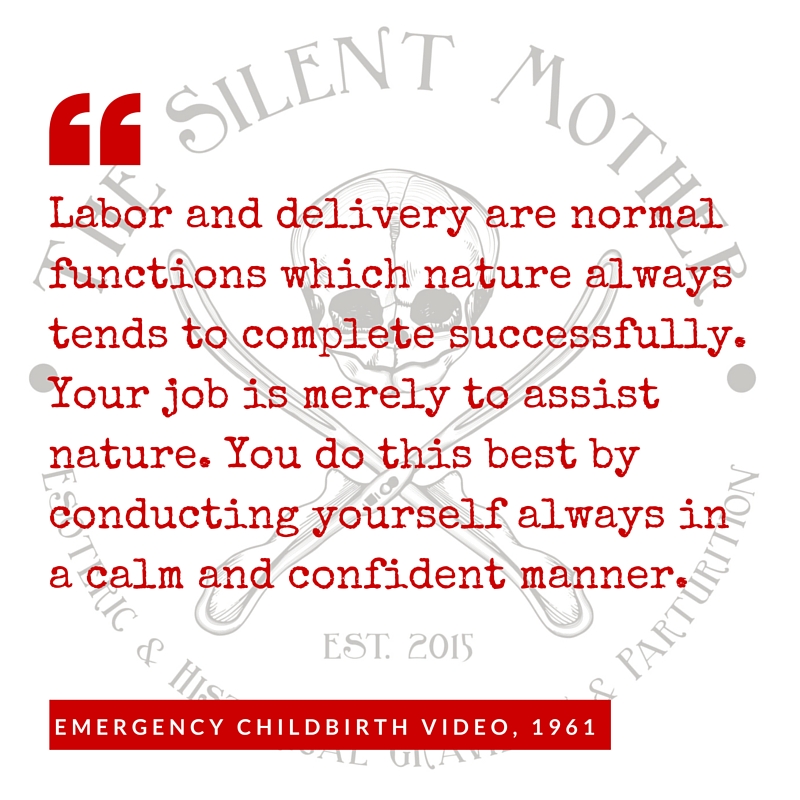
Emergency Childbirth in 1961

February 24, 2016 By Deena Leave a Comment

I recently came across this video, Emergency Childbirth 1961 US Navy Vintage Educational Film. There are certain aspects of the film which I heartily approve and other aspects which I am less fond.

emergency birth, Silent Mother, Deena BlumenfeldThe good:

Delayed cord clamping – The narrator advises the birth attendant not to clamp or tie the cord prior to the cord ceasing to pulse. This is a critical component, as it allows baby to get all of his blood and can reduce the need for resuscitation.

Support the mother’s perineum – To reduce the risk of tearing, the birth attendant uses his hand to support the tissues just below her vulva.

Attention to sterility – The use of gloves is noted and good hand washing. There were still births done in this era without gloves, especially at home.

Scope of practice – The narrator is explains when to transfer to hospital and what can be handled at home.

Breastfeeding – Breastfeeding is not only encouraged, but demonstrated. The benefits of breastfeeding for expelling the placenta and controlling postpartum bleeding are also covered.

Placenta –  Allowing the placenta to be born of it’s own accord, without any pulling or tugging on the cord.

Patience – It is emphasized a number of times that the birth attendant be patient with both the baby and the placenta.

The bad:

Mom gives birth flat on her back – This is the least effective pushing position and not recommended. My opinion is that laboring mothers should be giving birth in the position they find best and the birth attended should make accommodations for that position.

Shaved pubic hair – It was common practice up through the 1980’s to shave a woman’s pubic hair before birth. This was purported to be hygienic. However, we have since learned that shaving for birth increases risk of infection.

Camera angle – I think this one bothers me the most. The camera is pointed directly at the mother’s vulva so we can see the baby being born. However, it is a very dehumanizing angle. We see nothing of her face or the rest of her body to see how she is feeling or how well she is pushing. This angle is typical of birth depictions from obstetrical textbooks from the 1700’s onward. The disembodied woman’s parts were, in theory, to preserve her decency. However, it takes away her humanity.

No sound – The only sound we hear is that of the narrator. To provide a full and true perspective on birth, we must be able to hear the noises the laboring mother makes and the words her partner and her birth attendant says. This is a key missing piece.

I do think this video is worth your time. It does provide some insight into how birth was viewed in the early 1960’s and how far we still have to go. Fair warning, the video is very graphic, given the camera angle and the amount of blood shown. If you are squeamish, you may choose to skip watching it.

Please support The Silent Mother by becoming a patron through Patreon.

Your generous donation allows me to keep writing.

Patreon donation Silent Mother

Do share this article with your friends.

Filed Under: All Topics, History Tagged With: Childbirth, emergency birth, History of Pregnancy & Childbirth, videos

How is an Orgasm like Childbirth?

February 2, 2016 By Deena 1 Comment

Recently, one of my students asked me how she could make childbirth pleasurable. My eyes dilated and I was beaming from the thought answering of her query. I wanted to scream, “Yes, yes, yes! Birth can be pleasurable!” However, I restrained myself, as I was in front of a classroom full of students.

The rest of the class looked mildly aghast at this mother’s inquiry. So, I began to ruminate as to why they reacted in such a manner.

As a society, we have a reluctance to talk about sex, or even allude to it. We don’t even call our genitals by their proper names, for goodness sake!

We want to believe in virgin births and not to think that babies emerge from vaginas. We are loathe to imagine that not only do our cervixes stretch open to 10 cm, but so do our vaginal walls and our pelvic floors; that our bodies accommodate both things which go in as well as things which come out.

We tend to believe that the vagina, and breasts for that matter, serve one purpose – sex and pleasure. We forget that biology dictates that babies are born through the vagina and that breasts feed babies. This duality of purpose confounds our sensibilities. It creates an uncomfortable and conflicting state of mind.

We don’t like to sit with our discomfort. Rather, we do our best to avoid discomfort in the first place. It makes it that much more difficult to cope with discomfort when we are in the habit of avoiding it all together. This is one reason why some women preemptively seek pain medication for labor. It’s why women are told to “just get the epidural” by their friends and family.

We need to sit with our pain and experience it. Without the experience of pain, there is no pleasure to be appreciated. I ask you now, Dear Reader, to sit with your discomfort as you continue reading.

The stigma surrounding sex and pleasure runs deep in our culture.

It’s not polite.

It’s improper.

Someone may think badly of us for speaking of such things.

Sex is private.

 I’m a good girl.

 Sex is shameful. Except that it isn’t.

So what does all this have to do with birth?

Childbirth is sexual.

Hang on, what?

Yes, childbirth is sexual.

No, it can’t be! Sex is what I do with my husband. Birth is, it’s, um, a thing that happens. A bodily function…

It all seems to have a bit of a squick factor for many people; except, you can’t take sexuality out of birth. Birth is sexual. Birth is the direct result of sexual intercourse. They don’t call it “sexual reproduction” for nothing!

The merest suggestion that birth might not hurt; might be pleasurable; might even be orgasmic is bizarre to most, offensive to some.

With birth there is the biomechanical or physiologic process, but there is also a major social emotional component. To bring pleasure into childbirth, mothers must feel safe enough to surrender to their bodies and to the process.

Childbirth and Orgasm, The Silent MotherTo have an orgasm, one must surrender completely to the process. An uncomfortable body or, more precisely, a distracted mind will prevent us from not just experiencing orgasm but being able to fully enjoy the sensation. It’s the difference between the biomechanical process and a mind-blowing, eye brightening orgasm which leaves us in a state of euphoria for ages afterwards.

Both orgasm and childbirth need safe, private spaces so that the individual can give up control to their bodies. Giving up control, surrender, is fundamental to the experience of pleasure.

Think about it. If you have a luscious piece of chocolate cake and intend to eat the cake, but you are being observed by friends you are less likely to eat all of it. You’ll take a bite or two, but feel guilty. It’s not healthy, you tell yourself. I’ll gain weight. My friend who is on a diet will feel bad if I eat the cake in front of her, and so on.

Now, imagine you are at home, alone on the couch. You will eat that cake in its entirety and savor each bite. There is pleasure in the act of consuming your piece of chocolate cake. That pleasure wasn’t present in the previous scenario.

The setting, the people who surround you and your feeling of safety all converge to either aid or inhibit pleasure. The pleasure is in the surrender. Pleasure arises from a willingness to release control.

Mothers, give yourself permission to release the control you desire to have over the birthing process. Attempting to control the process creates tension. Tension creates fear and pain. Fear, tension and pain all feel the same in the body. They are different expressions of the same sensation. When you give yourself permission to surrender and the birthing space is quiet, dark and private, pleasure in the process can be had.

Please support The Silent Mother by becoming a patron through Patreon.

Your generous donation allows me to keep writing.

Patreon donation Silent Mother

Do share this article with your friends.

Filed Under: All Topics, Dirty Secrets Tagged With: Childbirth, Labor, Orgasm, Pain, Pleasure, Pregnancy, Sex, Sexuality

  • « Previous Page
  • 1
  • 2
  • 3
  • 4
  • 5
  • Next Page »

Follow Us

Visit Us On FacebookVisit Us On InstagramVisit Us On TwitterVisit Us On YoutubeCheck Our FeedVisit Us On Pinterest

Subscribe to The Silent Mother

Receive our blog posts in your in-box so you never miss a thing.


Donate

Please support The Silent Mother through Ko-fi.

Your generous donation allows me to keep writing.

Topics

Altruism Antique Medical Equipment Birth Control Bodily Autonomy Childbirth Childbirth Education Contraception Dear Diary Death Dr. Grantly Dick-Read Education Eugenics Faith Feminism Giving Birth With Confidence Good Girl Historical Fiction History of Pregnancy & Childbirth Human Rights IUD Labor Lamaze Medical Anthropology Medicine Motherhood Natural Childbirth Obstetrics Pain Personal Collection Physician Planned Parenthood Pleasure Politics Preaching Pregnancy Pro-choice Public Health Religion Reproductive Rights science Scopolamine Sexuality Twilight Sleep videos Women's Rights

Copyright © 2026 · Deena Blumenfeld · The Silent Mother

Visit Us On FacebookVisit Us On InstagramVisit Us On TwitterVisit Us On YoutubeCheck Our FeedVisit Us On Pinterest